Real or artificial Christmas tree: which one wastes less?
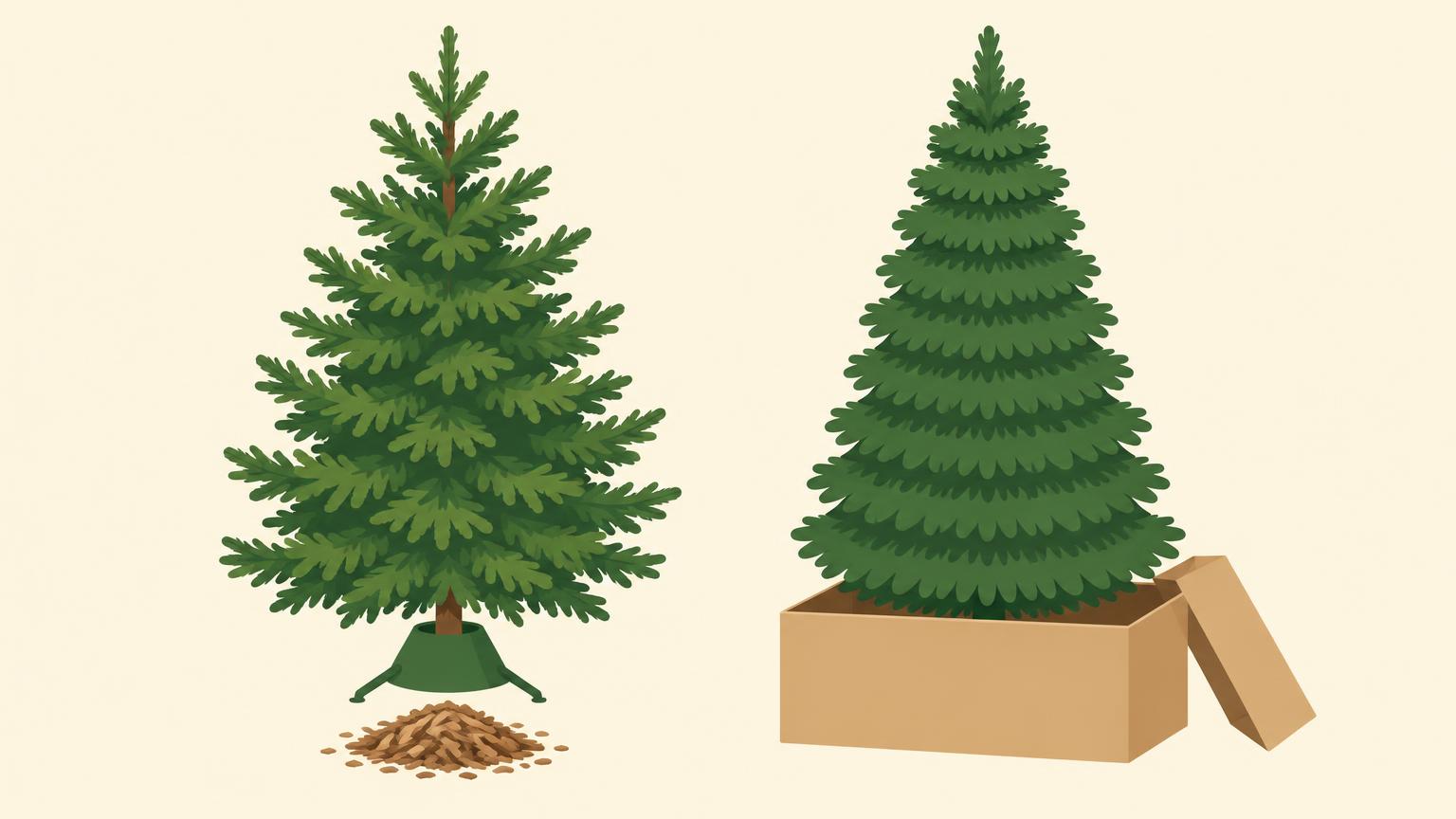
If you already own an artificial tree, keep using it for as long as it lasts: throwing it out early would be the most wasteful choice of all. If you are choosing fresh, a real tree that gets chipped or composted after Christmas usually wastes less than a new artificial one, unless you are confident you will keep the artificial tree for around 10 years. How you dispose of a real tree, and how long you keep a fake one, matter far more than which kind you pick.
What the numbers say
Figures widely reported from the Carbon Trust, a UK sustainability consultancy, put the footprint of a 2 meter (about 6½ foot) tree like this:
| Tree | Approximate footprint |
|---|---|
| Artificial tree | 40 kg CO2e |
| Real tree, sent to landfill | 16 kg CO2e |
| Real tree, chipped or burned | 3.5 kg CO2e |
The artificial tree's footprint comes mostly from making it, so nearly all of it is spent before the tree reaches your house. After that, it spreads across every Christmas you use it. On those numbers, an artificial tree beats a chipped real tree after roughly 10 to 12 years, and a landfilled real tree after about 3.
You will see other break-even figures. A 2018 study commissioned by the American Christmas Tree Association, which represents artificial tree makers, put the break-even at 4.7 years. Keep the source in mind when you read that one. Bert Cregg, a horticulture and forestry professor at Michigan State University, points out that the result depends heavily on assumptions, such as how far you drive for a real tree and how long you keep a fake one.
No one number settles it, and the conclusion holds up across them: use an artificial tree for a long time, and do not send a real one to landfill.
The case for a real tree
Real trees are a crop. They grow on farms for several years and can be chipped into mulch or composted when you are done, so what is left goes back into the soil. In a landfill, the same tree breaks down slowly and releases methane, which is why disposal changes the figures so much.
Your trip matters too. Cregg estimates that a 10-mile drive each way can roughly cancel out the carbon a tree stored while it grew. So buy close to home, or pick one up on a trip you were already making.
The case for an artificial tree
An artificial tree makes sense if you will really keep it for a decade or longer, and if you do not have an easy way to recycle a real one. Most are made with PVC and metal, which are hard to separate, so they generally cannot go in curbside recycling and tend to end up in landfill.
If you want one, buying secondhand is the best route. The carbon is already spent, and you are keeping a tree out of the trash. Look on local buy-and-sell groups and at thrift stores in January, when people are clearing out.
How to waste less with a real tree
- Measure before you buy. A tree that is too tall means sawing off the top and wasting part of what you paid for.
- Keep it watered. A well-watered tree holds its needles longer and stays safer in the house. Check the stand daily.
- Find your recycling option before Christmas. Many towns collect trees for a few weeks in January or run drop-off points. Search your city or county's waste page.
- Strip it completely. Take off all lights, tinsel, hooks and stands. Most programs turn trees into mulch, and a stray piece of metal or tinsel can spoil a load. Do not put it in a plastic bag.
- Do it yourself if you have the space. Cut small branches for mulch around shrubs, or add chopped pieces to a home compost pile. They break down slowly, so chop them small. Do not burn a Christmas tree indoors, because it can throw sparks.
A potted tree with roots can be another option if you have outdoor space and a climate that suits it. Keep it indoors for only a short time and plant it or keep it in its pot outside afterward. Many do not survive, so treat this as a project and not a sure thing.
How to waste less with an artificial tree
- Store it carefully. Keep it in a sturdy box or bag somewhere dry, so branches do not get crushed. Damage is one of the most common reasons people replace one.
- Fix before you replace. A bare spot can face the wall, and a broken stand can often be replaced by itself.
- Pass it on. If you want a different tree, offer the old one to a neighbor, school, church or community group while it still looks good.
- Check before you bin it. If it is past saving, your local waste service can tell you how to dispose of it. It should not go in with your regular recycling, since it can jam sorting machines.
Quick answer by situation
- You have an artificial tree already: keep it until it wears out.
- You rent and have no way to get rid of a real tree: a secondhand artificial tree is a good fit.
- You have a local tree farm or lot and a collection program: a real tree is hard to beat.
- You are not sure you want a tree long term: try a real one, as there is no multi-year commitment.
The decorations add to the total, too. Reusable ornaments, and fewer single-use items in general, do more over the years than most people expect.
